


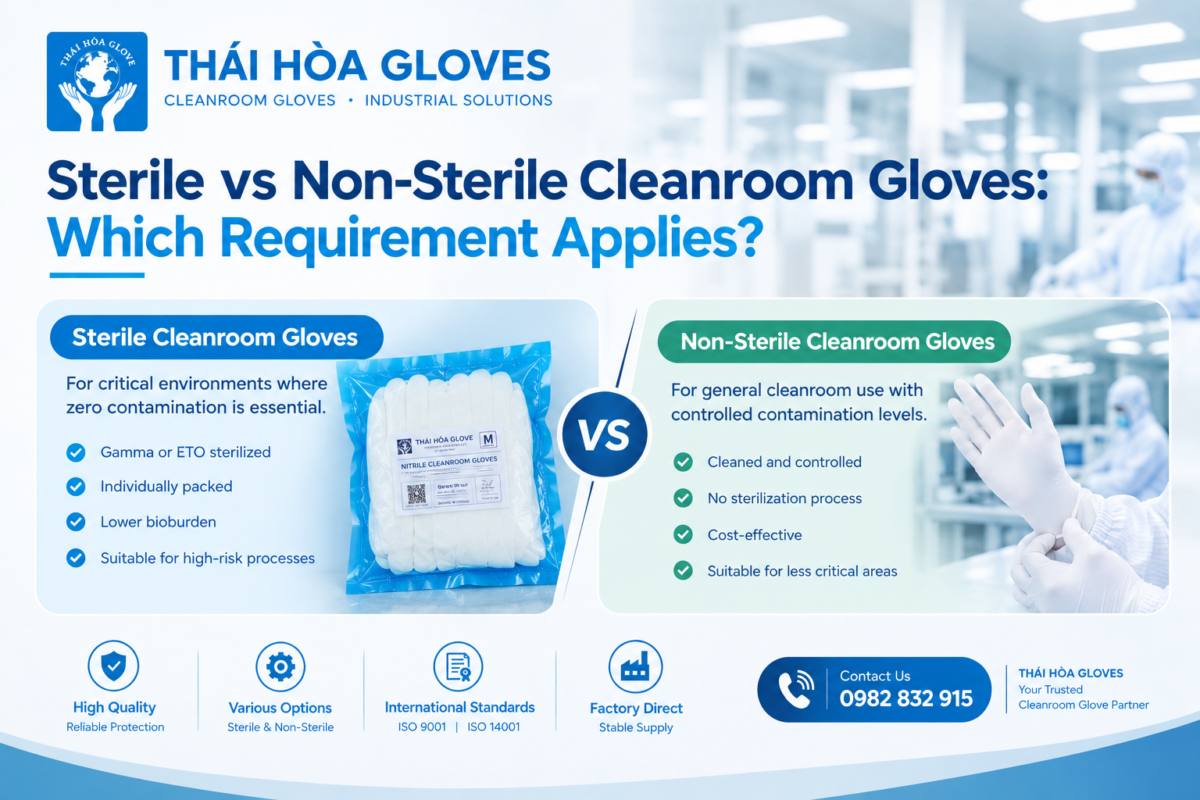
Sterile and non-sterile gloves serve different requirements. The process determines whether sterile supply is needed; a particle-cleanliness description does not establish it.
Start with the operation
Identify the approved task requirements rather than inferring them from room appearance or a pharmaceutical label. Have the quality team define evidence and handling expectations.
Avoid unsupported substitutions
Similar dimensions and low particle data do not make a non-sterile model an acceptable replacement where sterility is required. Conversely, sterile supply does not answer every residue or handling criterion.
Link selection to the controlled process
Define the operation
Identify product contact, area conditions and whether the task requires sterile gloves. Cleanliness, sterility and chemical protection are separate considerations. A broad pharmaceutical-use description does not settle the requirements of a particular process.
Assemble the relevant evidence
Obtain product identification, technical specifications, packaging details and the records required by the responsible quality team. Where sterile supply is required, confirm the evidence and handling conditions appropriate to that application.
The European Commission publishes GMP guidance, including Annex 1 for sterile medicinal products, through EudraLex Volume 4. A glove description alone does not establish compliance of a production process.
Evaluate the entire route to use
Receiving, storage, transfer, opening and donning can affect the result. Review packaging with the teams who perform those steps, and check whether the intended sequence can be followed consistently in the available space.
Document the approved model, use conditions and replacement events. Assess changes to formulation, packaging, supplier or procedure before assuming the original approval still applies. If disinfection is part of the process, address the product and treatment combination through the approved procedure.
Link feedback to lot information and actual operating conditions. This helps distinguish a material issue from a problem introduced during transfer or use, and provides a sound basis for discussions with the supplier.
Make the required product status explicit
For pharmaceutical cleanroom gloves, state whether the operation requires a sterile product and what evidence must accompany it. Keep sterility, particle cleanliness and other performance requirements as distinct entries in the specification. This helps purchasing ask the right questions and prevents a cleanroom category name from being used as a substitute for the required product status.
The approval record for pharmaceutical cleanroom gloves should identify the exact model, packaging and documents that were reviewed. Ask the supplier to explain how those documents connect to delivered lots. Where a requirement belongs to the site’s validated process, involve the responsible quality personnel before approving a replacement. A general product recommendation cannot establish suitability for every controlled pharmaceutical operation.
Follow package identity to the point of use
The handling plan for these gloves should identify each packaging layer and the stage at which it is removed. Check how operators retain the product identity after the outer carton is discarded. Labels, lot information and expiry details need to remain accessible in the manner required by the site’s procedure. Consider the transfer route as well as the final workstation.
Before introducing pharmaceutical cleanroom gloves, define how a damaged, unclear or unexpected package is handled. Operators should know where to place it and who can decide the next action. Include examples in training so these situations are recognized consistently. Do not ask staff to infer product status from appearance alone. The record should preserve the connection between what was approved and what was actually supplied.
Review any permitted treatment as part of the process
For pharmaceutical cleanroom gloves, any proposed treatment during use must be reviewed for the exact product and the controlled process. Ask what compatibility information is available and which conditions were assessed. A statement about the glove material alone may not address the complete product, the treatment agent or repeated use of that treatment. Keep the technical question specific.
Decisions about pharmaceutical cleanroom gloves should distinguish a validated site procedure from an informal practice. Involve the appropriate quality and technical personnel and retain their decision with the work instruction. If the product changes, check whether the supporting evidence remains applicable. Operators should follow the approved procedure rather than experimenting with cleaning or reuse to extend the life of a disposable item.
Plan a controlled supplier change
A change involving pharmaceutical cleanroom gloves should start with a comparison of the existing and proposed configurations. Identify differences in model, package, dimensions, supporting evidence and handling instructions. Consider which part of the current approval depends on those attributes. This gives the quality team a focused list of questions instead of an unstructured request to approve a new supplier.
When reviewing pharmaceutical cleanroom gloves, plan the transition so approved old and new stock remain distinguishable. Communicate the effective date and update the records used by purchasing and operators. Retain the reason for the change and the evidence supporting it. If a trial or further evaluation is required, complete it through the site’s process before treating the new configuration as interchangeable.
Observe the complete handling sequence
Assessment of pharmaceutical cleanroom gloves should include the sequence from pack opening to the end of the task. Observe where hands, sleeves, tools and packaging make contact. Ask operators which steps are difficult to repeat consistently and record those observations for the responsible process team. The review should use the garments and workstation arrangement that are actually intended for use.
For pharmaceutical cleanroom gloves, recurring adjustments or uncertainty about a step should lead to a review of the procedure. Confirm that the approved product sizes are available and that instructions match the supplied package. Training should describe how to report an unexpected situation without improvising a different process. This helps connect the documented approval with the routine work performed across different shifts.
Assign ownership to the next practical action
A decision about pharmaceutical cleanroom gloves often involves purchasing, operations and a technical reviewer. Each team should know what information it owns and what remains unresolved. A short action record can identify the question, the person responsible and the evidence needed to close it. This prevents a sample, a quotation and a specification from progressing independently with different assumptions.
When introducing pharmaceutical cleanroom gloves, confirm who can approve the product for the named operation and who updates the relevant instructions. Give operators a clear contact for unexpected differences in the supplied item. Keep the communication focused on the actual decision rather than collecting documents without a purpose. Ownership makes the review easier to complete and helps the approved arrangement survive normal staff changes.
Use a practical example before broad introduction
Consider a team evaluating pharmaceutical cleanroom gloves for an existing operation. A useful first step is to describe one representative task, list its mandatory requirements and identify the configuration currently in use. The team can then review the proposed product against those requirements and plan any appropriate trial. The example is a method for organizing the decision, not evidence that a particular model will perform better.
For pharmaceutical cleanroom gloves, record what would count as an acceptable result before the comparison starts. Keep the conditions consistent enough to interpret the observations and note any differences that cannot be controlled. After the review, connect the decision to the product identity and the approved task. This provides a repeatable approach when another size, supplier or operating condition needs consideration later.
Make the introduction understandable at the workstation
After approval of pharmaceutical cleanroom gloves, translate the technical decision into concise operating information. Show the product identity, available sizes, the tasks covered and the relevant handling instructions. Explain where staff should obtain a replacement and how to report a discrepancy. Operators should be able to follow the arrangement without searching through the complete purchasing correspondence.
The introduction of pharmaceutical cleanroom gloves should also include the people who replenish supplies and receive deliveries. Their records need to use the same product descriptions as the workstation instructions. Check that superseded alternatives are not left beside the approved stock without a clear status. This reduces confusion during busy periods and keeps routine supply aligned with the configuration that was actually assessed.
Review performance after the change
Follow-up on pharmaceutical cleanroom gloves should collect observations that can lead to a decision. Record the task, product code and size when staff report a problem. Separate a delivery issue from a fit issue or an unanswered technical requirement. These distinctions make it possible to direct the question to the right person and avoid replacing a product for a problem caused elsewhere.
A practical approval checklist
- Describe the job: record the materials handled, operating conditions and required performance.
- Identify the model: connect the product and packaging to the relevant evidence.
- Evaluate the task safely: use agreed acceptance criteria and involve the responsible technical and operating teams.
- Keep the decision: retain the approved specification, sample identity and handling instructions.
- Review changes: assess meaningful differences before introducing a substitute.
This sequence gives purchasing, quality and production a shared basis for discussion. If information is missing, request the specific evidence needed rather than treating an unanswered question as a pass.
Frequently Asked Questions
Does cleanroom mean sterile?
No. Cleanliness and sterility are distinct attributes.
Does a cleanroom designation establish sterility?
No. Cleanliness and sterility are distinct requirements supported by different evidence.
Discuss Your Requirements with Thái Hòa Gloves

Thái Hòa Gloves lists Regular nitrile, Class 100, Class 1000 and ESD options in its product range. Send the application, required specifications, size mix, quantity and delivery destination to discuss a suitable model and request a quotation. Confirm specialized suitability, availability and delivery terms for the actual product and order.
- WhatsApp / international contact: +84 982 832 915
- Email: info@thaihoagloves.com
- Website: thaihoagloves.com/en


