

In the world of semiconductor fabrication, the margin for error is non-existent. As microchips shrink to 2nm and below in 2026, a single microscopic particle or a stray static discharge can destroy an entire silicon wafer, costing companies millions of dollars in lost yield.
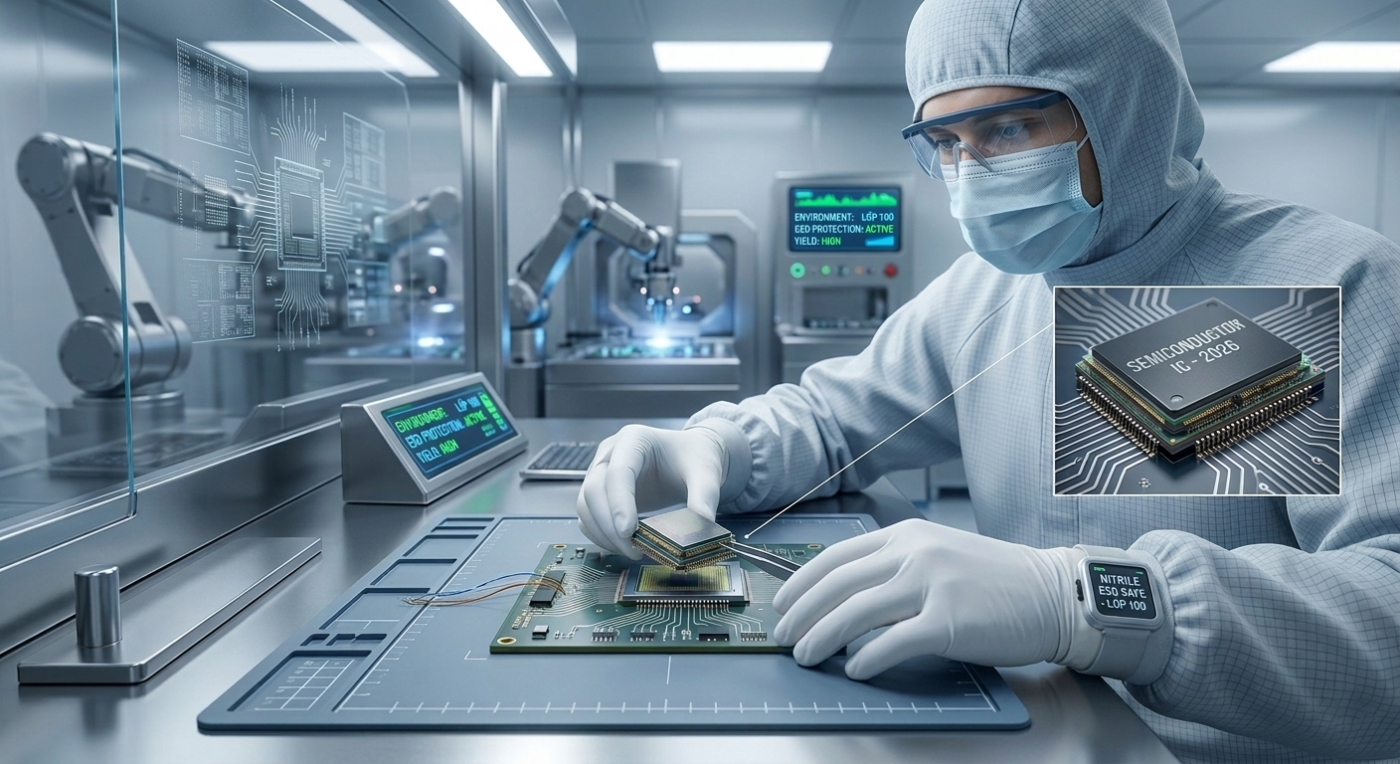
Cleanroom gloves are the primary barrier between the human operator—the largest source of contamination—and the sensitive components. This ultimate guide explores the critical requirements, technical standards, and selection criteria for semiconductor-grade gloves.
1. Why Semiconductors Demand Specialized Gloves
Unlike general laboratory or medical environments, semiconductor cleanrooms (Fabs) have two unique “enemies”: Particulate Matter and Electrostatic Discharge (ESD).
A. Controlling Ionic Contamination
Semiconductors are highly sensitive to metallic ions such as Sodium (Na+), Potassium (K+), and Chloride (Cl-). If these ions transfer from a glove to a wafer, they can alter the electrical properties of the silicon, leading to catastrophic device failure.
B. ESD Protection
Static electricity is the silent killer of microchips. A person walking across a floor can generate thousands of volts. Semiconductor gloves must be ESD-safe, meaning they have a surface resistance typically between 10^6 and 10^10 \Ω to safely dissipate static charges.
2. Material Excellence: Why Nitrile Rules the Fab
While Latex and Vinyl have their places, Nitrile is the gold standard for semiconductor environments in 2026.
- Superior Cleanliness: Nitrile can be extensively washed in Deionized (DI) water to reach ultra-low levels of particles and extractable ions.
- Latex-Free: Eliminates allergy risks, ensuring a safe workplace for all operators.
- Chemical Resilience: Nitrile withstands common Fab chemicals like Isopropyl Alcohol (IPA) and various etching acids better than other materials.
- High Puncture Resistance: Essential for handling sharp-edged lead frames and silicon shards.
3. Understanding ISO Classifications for Gloves
Cleanroom gloves are categorized based on the number of particles they release. For semiconductors, you must match the glove to your ISO 14644-1 environment.
| Cleanroom Grade | ISO Equivalent | Recommended Glove Processing |
| Class 10 | ISO 4 | Ultra-cleaned, triple-DI washed, vacuum packed. |
| Class 100 | ISO 5 | DI washed, processed in a Class 100 environment. |
| Class 1000 | ISO 6 | Powder-free, high-quality cleanroom grade. |
4. Key Technical Specifications to Audit
When evaluating a supplier’s Technical Data Sheet (TDS), look for these four critical metrics:
1. Liquid Particle Count (LPC)
This measures the number of particles per square centimeter. For ISO Class 4 or 5 environments, the LPC should be extremely low (typically < 800 or < 1200 counts at 0.5 microns).
2. Surface Resistance
As mentioned, for ESD sensitive areas, the glove must fall within the dissipative range. Check for compliance with ANSI/ESD SP15.1.
3. Non-Volatile Residue (NVR)
This measures the “silicone-free” nature of the glove. Silicone contamination is a nightmare in Fabs as it prevents thin-film adhesion.
4. Glove Length
Standard 9-inch gloves are insufficient. Semiconductor professionals use 12-inch (300mm) or even 16-inch gloves to ensure the cuff covers the cleanroom garment sleeve, preventing skin particles from escaping the wrist area.
5. Best Practices for Glove Usage in Fabs
Even the best glove fails if used incorrectly. Follow these Standard Operating Procedures (SOPs):
- Double Gloving: Many Fabs require an inner glove (often sterile or high-tactility) and an outer cleanroom nitrile glove for added redundancy.
- Glove Changing Frequency: In high-yield environments, gloves should be changed every 2 hours or whenever they touch a non-clean surface.
- IPA Sanitization: Operators should regularly spray their gloved hands with 70% IPA to maintain surface cleanliness during the shift.
6. Procurement and Supply Chain in 2026
The semiconductor industry is prone to rapid scaling. Your glove supplier must offer:
- Lot Traceability: Every bag of gloves must be traceable back to the raw material batch.
- Bulk Stability: A consistent supply is vital; a “stock-out” can halt a billion-dollar production line.
- Certificate of Analysis (COA): Every shipment should arrive with a COA proving the gloves met the particle and ESD specs during testing.
7. Future Trends: Sustainability in the Cleanroom
In 2026, many semiconductor giants are moving toward circular economy goals.
- Biodegradable Nitrile: New formulations allow gloves to break down in landfills without compromising cleanroom integrity.
- Glove Recycling Programs: Some manufacturers now offer programs to collect used, non-hazardous cleanroom gloves to turn them into plastic lumber or secondary materials.
Conclusion
Choosing the right cleanroom gloves for semiconductors is a balance of science, safety, and economics. By focusing on low NVR, strict ESD control, and proper ISO ratings, you protect your most valuable asset: the wafer.
Are you looking for high-yield protection for your Fab?
Thai Hoa Gloves for a comprehensive audit of your cleanroom glove requirements and to request samples of our ISO Class 4 Nitrile series.