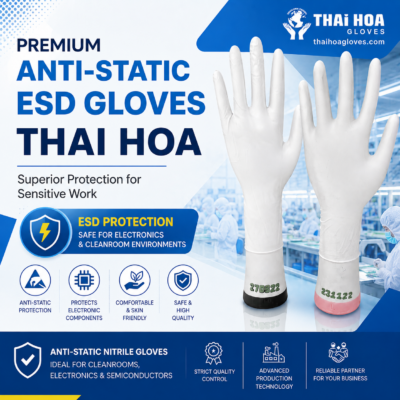


In the world of semiconductor fabrication, where a single 10-nanometer particle can cause a catastrophic “killer defect,” the choice of hand protection is a multi-million dollar decision. Disposable nitrile gloves have become the industry standard, replacing latex and vinyl due to their superior chemical resistance and electrostatic properties.
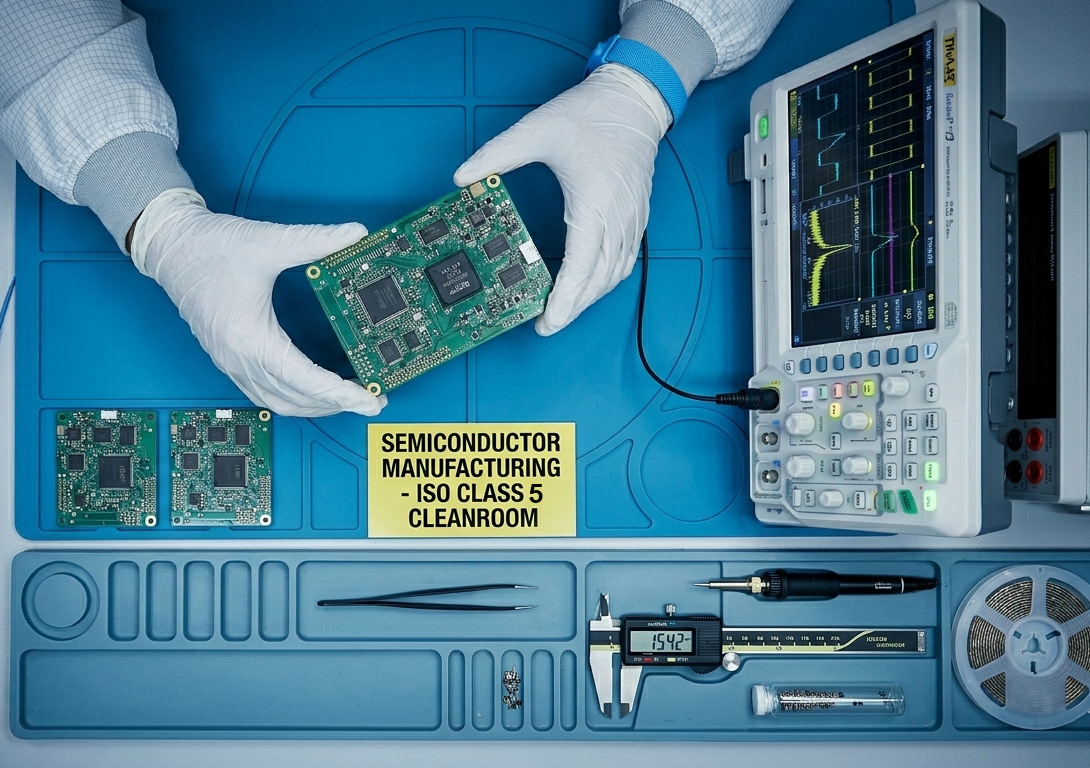
This guide provides an in-depth analysis of the best nitrile gloves for semiconductor environments, focusing on contamination control, ESD safety, and tactile precision.
1. Why Nitrile is the Gold Standard for Semiconductors
Semiconductor manufacturing occurs in highly controlled cleanrooms (ISO Class 1000 to Class 100). Nitrile (acrylonitrile-butadiene) offers several critical advantages over other elastomers:
- Zero Ionic Contamination: High-grade nitrile gloves are washed in deionized (DI) water to remove trace elements like Sodium, Potassium, and Magnesium, which can poison silicon wafers.
- Superior Chemical Barrier: Nitrile resists common fabrication chemicals such as Isopropyl Alcohol (IPA), etching acids, and photoresist developers better than latex.
- Static Dissipation: Nitrile possesses inherent anti-static properties, making it safer for handling ESD-sensitive MOSFETs and integrated circuits.
2. Top-Rated Features of Best-in-Class Gloves
When searching for the “best” gloves, procurement managers must look beyond price and focus on these technical benchmarks:
A. Ultra-Low Particulate Shedding
The best gloves for semiconductors are certified for ISO Class 5 (Class 100) cleanrooms. They undergo a “chlorination” process that smooths the surface, preventing the material from flaking or shedding micro-particles during high-dexterity tasks.
B. ESD and Surface Resistance
In semiconductor assembly, friction-induced charges can reach thousands of volts. The best disposable nitrile gloves are Static Dissipative, with a surface resistance typically ranging between 10^6 and 10^10 \Ω. This allows charges to bleed off safely to the ground via the operator’s wrist strap.
C. Length and Thickness
Standard 9-inch gloves are often insufficient. The best options are 12-inch (300mm) extended cuffs.
- Extended Cuffs: Ensure that the gap between the glove and the cleanroom garment (bunny suit) is sealed, preventing skin flakes from escaping.
- Mil Thickness: A 4-mil to 5-mil thickness provides the perfect balance between puncture resistance and the “second-skin” feel needed for handling delicate wafers.
3. Comparison of Top 3 Nitrile Glove Types for Fabrication
| Feature | Cleanroom-Laundered Nitrile | Accelerator-Free Nitrile | High-Tactility Nitrile |
| Best For | ISO Class 3-5 Cleanrooms | Workers with Skin Allergies | Micro-component assembly |
| Purity Level | Extremely High (DI Washed) | High | Standard Clean |
| ESD Performance | Excellent | Good | Excellent |
| Chemical Resistance | High | Moderate | Moderate |
4. The Critical Role of Accelerator-Free Formulations
A growing trend in the best semiconductor facilities is the move toward Accelerator-Free Nitrile Gloves. Traditional nitrile manufacturing uses sulfur-based accelerators (like thiurams or carbamates) to speed up vulcanization.
- Health Benefit: Prevents Type IV chemical allergies in workers.
- Product Benefit: Eliminates the risk of sulfur outgassing, which can tarnish silver or copper bonding pads on the semiconductor surface.
5. Conclusion: Choosing the Right Protection
The best disposable nitrile glove for semiconductor manufacturing is one that balances ISO-certified cleanliness with ESD-safe performance. By opting for DI-washed, 12-inch, accelerator-free nitrile, facilities can significantly reduce contamination-related yield losses.
Investing in high-specification hand protection is not an expense—it is an insurance policy for your silicon yield.
Technical Summary for Engineers
- Material: 100% Synthetic Nitrile.
- Standard Compliance: ASTM D6319, IEST-RP-CC005.4.
- Cleanliness: ISO Class 100, 1000
- Packaging: Vacuum-sealed in anti-static polybags.
Does your current facility require ISO Class 1000 certification, or is ISO Class 1000 sufficient for your specific assembly line?