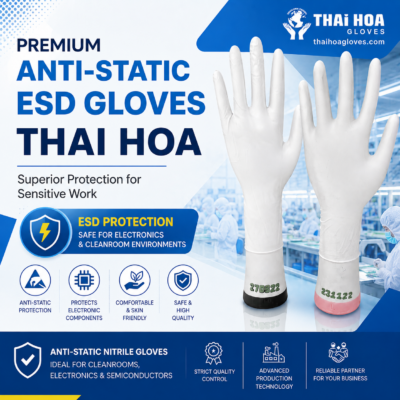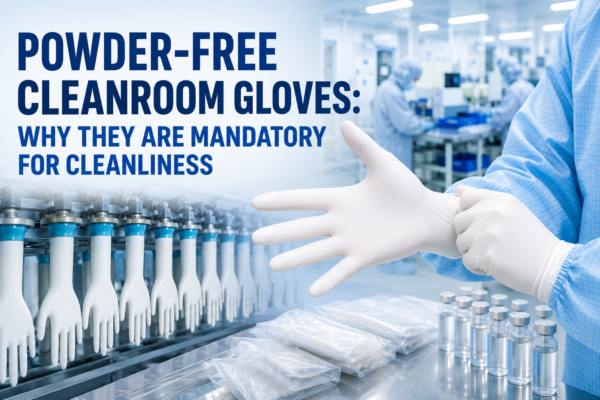


In the world of high-precision electronics and micro-assembly, the margin for error is measured in microns. While protective gear is designed to shield the worker, in electronics, the gear must primarily shield the product. This is where powder-free disposable gloves become an uncompromising requirement.
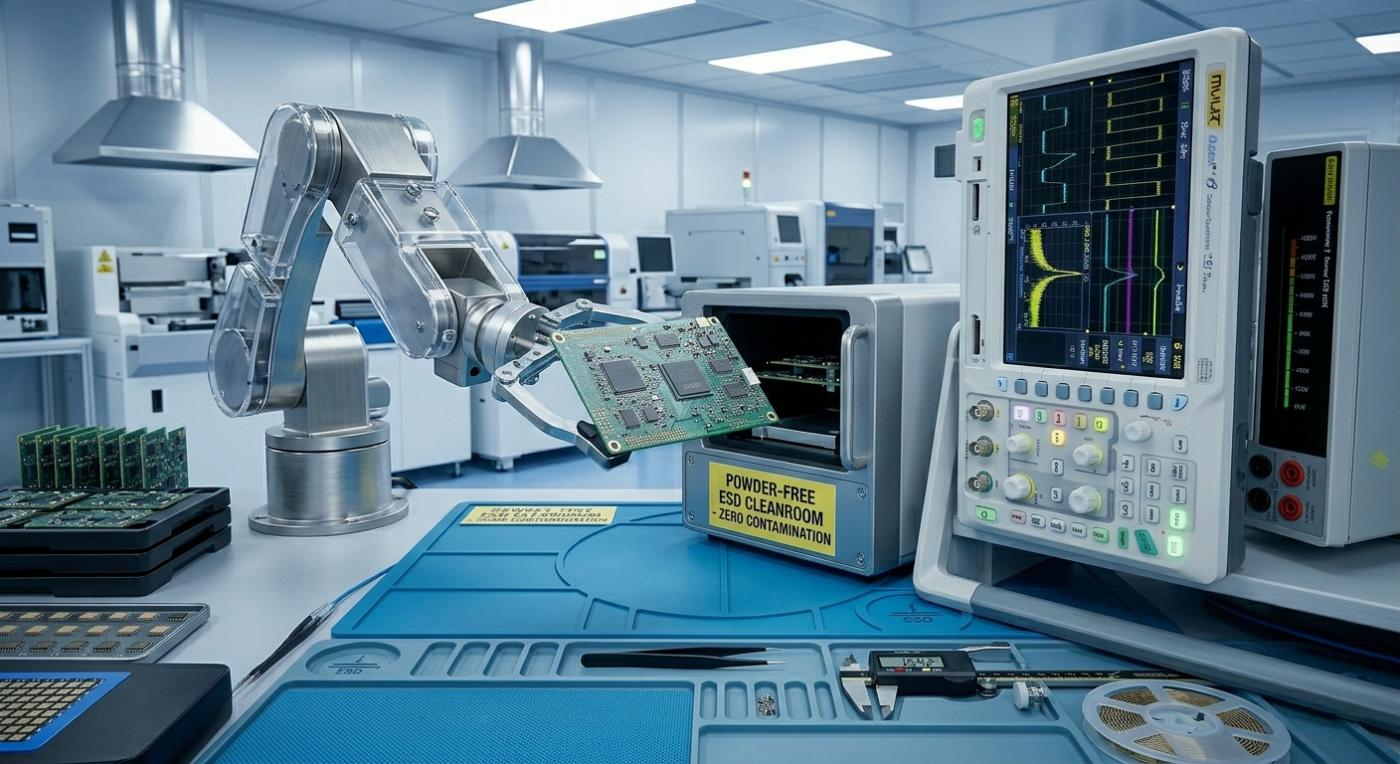
For sensitive circuits, a single grain of cornstarch—the common lubricant in powdered gloves—can act as a massive bridge for short circuits or a catalyst for corrosion. This article explores why powder-free technology is the non-negotiable standard for zero-contamination environments.
1. The Anatomy of Contamination: Why Powder is the Enemy
Traditional disposable gloves often use USP grade cornstarch to make them easier to don. While harmless in food service or general exams, this powder is a “killer” in electronics manufacturing for three primary reasons:
A. Particulate Migration
Powder particles do not stay inside the glove. They become airborne during donning and doffing, settling on printed circuit boards (PCBs) and silicon wafers. In a cleanroom, these particles disrupt the laminar airflow and contaminate sensitive machinery.
B. Chemical Interference
Cornstarch is organic. When it settles on a circuit that undergoes soldering or high-heat processing, it can carbonize, leading to:
- Parasitic Leakage: Unintended electrical paths between conductive traces.
- Solder Voids: Preventing a clean bond between the component and the board.
C. Moisture Absorption
Powder is hygroscopic—it attracts moisture. If powder remains on a circuit, it can trap humidity against metal traces, leading to dendritic growth (microscopic metallic “ferns” that grow between conductors and cause short circuits over time).
2. Technical Standards for Zero Contamination
To achieve “Zero Contamination,” gloves must meet specific international benchmarks. When sourcing powder-free gloves for sensitive circuits, look for these technical specifications:
| Specification | Standard / Metric | Why it Matters |
| Cleanliness Class | ISO | Ensures the glove sheds fewer than a specified number of particles. |
| Extractable Ions | <1.0μg/cm2 (Sodium, Chloride) | Prevents “ionic poisoning” of semiconductors. |
| Non-Volatile Residue (NVR) | Low NVR levels | Ensures no oily film or “outgassing” occurs under vacuum. |
| ESD Surface Resistance | 10^6 to 10^10Ω | Safely dissipates static without causing a sudden spark. |
3. Beyond Powder: The “Clean” Manufacturing Process
Being “powder-free” is just the starting point. High-end gloves for sensitive circuits undergo a Chlorination Process or a Polymer Coating to ensure they are easy to wear without the need for dust.
The Chlorination Advantage
By treating the glove with a chlorine solution, the surface becomes smoother and less “tacky.” This process also reduces the protein content in latex gloves (minimizing allergies) and strips away residual chemicals from the manufacturing mold, further lowering the risk of chemical transfer to the circuit.
DI Water Washing
The best gloves for sensitive electronics are laundered in Deionized (DI) Water. This removes surface ions that could otherwise cause corrosion on copper, gold, or silver contacts.
4. Nitrile vs. Other Materials for Circuit Safety
While several materials are available, Nitrile is the undisputed leader for sensitive electronics.
- Latex: High elasticity but contains natural proteins and often requires powder. Even powder-free latex can have high ionic content.
- Vinyl: Inexpensive but highly prone to “outgassing” and shedding particles. It also has poor ESD properties.
- Nitrile: Inherently anti-static, powder-free by design, and highly resistant to the solvents (like IPA) used to clean flux off circuit boards.
5. ESD Protection: The Second Pillar of Circuit Safety
A powder-free glove that isn’t ESD-safe is still a hazard. Sensitive circuits can be damaged by as little as 10 Volts of static electricity.
Static Dissipative powder-free nitrile gloves allow electrical charges to flow across the surface of the glove to a grounded point (like a wrist strap) rather than accumulating and jumping to the circuit. This “controlled bleed” of electricity is what differentiates a standard powder-free glove from an Electronics-Grade glove.
6. Implementation Checklist for Cleanroom Managers
To ensure your facility maintains a zero-contamination profile, follow these best practices:
- Verification: Request a Certificate of Analysis (COA) from your glove supplier to verify particle counts and ion levels.
- Storage: Keep gloves in their original cleanroom-compatible packaging. Do not store them near cardboard, which is a major source of cellulose dust.
- Donning Protocol: Use “Touch-Free” donning techniques. Never touch the fingertips of the glove with bare skin during the donning process.
- Disposal: Treat gloves as single-use only. Once removed, the internal sweat and skin oils compromise the glove’s integrity.
7. Conclusion: The ROI of Cleanliness
Switching to high-quality, powder-free disposable gloves is a strategic investment. The cost of a pair of gloves is a fraction of the cost of a failed satellite component, a faulty medical device, or a recalled automotive ECU. By eliminating powder and controlling particulates, you ensure that your sensitive circuits perform exactly as engineered.
Thai Hoa Industrial Development Investment., JSC.
Address: Lot TT3, Diem Thuy Industrial Park, Pho Yen Ward, Thai Nguyen Province, Vietnam
Tel: 0208 393 1991 – Hotline: 0982 832 915
Email: info@thaihoagloves.com
Whatsapp: +84982832915