

In semiconductor manufacturing, wafer handling requires strict control of contamination, particles, and physical damage. Even a small amount of contamination can affect wafer quality, production yield, and overall manufacturing efficiency.
That is why disposable gloves for wafer handling are an essential part of cleanroom operations. The right gloves must provide not only excellent purity and low particle generation but also sufficient puncture resistance, chemical resistance, and tactile sensitivity for precision work.
Why Are Disposable Gloves Important for Wafer Handling?
Semiconductor wafers are highly sensitive to particles, oils, moisture, and other contaminants. Direct contact with bare hands can introduce skin oils, sweat, and microscopic particles onto wafer surfaces.
Disposable cleanroom gloves create a protective barrier between operators and sensitive semiconductor components.
High-quality gloves for wafer handling should help:
- Minimize particle contamination
- Reduce fingerprints and skin-oil transfer
- Protect wafers from direct hand contact
- Improve operator hygiene
- Provide reliable grip and tactile sensitivity
- Reduce the risk of glove-related contamination
- Support cleanroom manufacturing requirements
For semiconductor factories, choosing the correct glove material and quality level is therefore an important part of contamination control.
Puncture Resistance: An Important Glove Performance Factor
Although wafer handling is generally a delicate process, operators may work with equipment, trays, containers, tools, and sharp edges. A glove that tears or punctures easily can expose the operator’s hands and potentially introduce contamination into the production environment.
Puncture resistance refers to the ability of a glove material to resist penetration by sharp or pointed objects.
For cleanroom applications, good puncture resistance can provide several benefits:
1. Better Hand Protection
A stronger glove can provide an additional level of protection when operators handle equipment, wafer carriers, containers, or manufacturing tools.
2. Reduced Risk of Glove Damage
Glove tears can occur during repetitive handling operations. A durable glove helps reduce unexpected damage and the need for frequent replacement.
3. Improved Manufacturing Efficiency
Frequent glove changes can interrupt production processes. Gloves with appropriate mechanical strength can help operators work more efficiently while maintaining cleanroom practices.
However, puncture resistance should not be considered independently. For wafer handling, purity and contamination control remain equally important.
Purity and Low Contamination Are Critical
In semiconductor manufacturing, glove cleanliness can have a direct impact on process quality.
Disposable gloves used for wafer handling should be manufactured and packaged to minimize unwanted contaminants such as:
- Particles
- Residual chemicals
- Extractable substances
- Silicone or other unwanted residues
- Powder
- Skin-contact contaminants
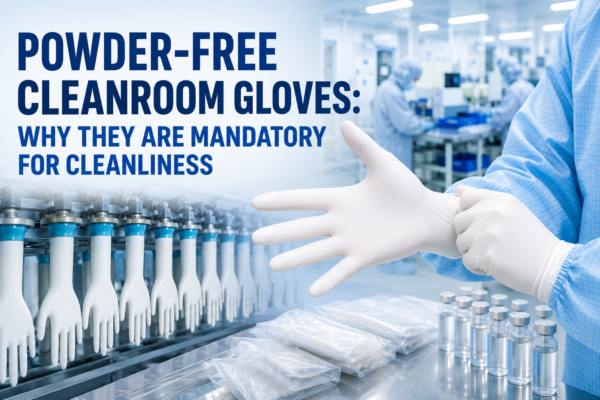
For this reason, powder-free gloves are commonly preferred in cleanroom and semiconductor applications.
The manufacturing process, washing process, packaging, and storage conditions can all influence glove cleanliness.
Nitrile Gloves for Wafer Handling
Nitrile gloves are widely used in industrial, laboratory, electronics, and cleanroom environments because of their combination of durability, flexibility, and chemical resistance.
For wafer handling applications, nitrile gloves can offer several advantages:
- Powder-free options
- Good puncture resistance
- Good tactile sensitivity
- Flexible fit
- Resistance to many common chemicals
- Suitable for repetitive handling
- Available in cleanroom-compatible specifications
However, not every nitrile glove is suitable for semiconductor production.
Standard industrial nitrile gloves may not provide the cleanliness level required for critical cleanroom environments. Semiconductor manufacturers should therefore evaluate gloves based on their intended cleanroom classification, manufacturing process, cleanliness, packaging, and quality-control requirements.
Cleanroom Gloves vs. Standard Disposable Gloves
There is an important difference between ordinary disposable gloves and gloves designed specifically for cleanroom applications.
| Feature | Standard Disposable Gloves | Cleanroom Gloves |
|---|---|---|
| Particle control | Basic | High |
| Powder-free options | Available | Commonly required |
| Cleanliness | General use | Controlled manufacturing |
| Packaging | Standard | Cleanroom-compatible |
| Semiconductor applications | Limited | Suitable for specific processes |
| Contamination control | Moderate | Higher priority |
For wafer handling, simply choosing a disposable glove is not enough. The glove should be selected according to the cleanliness requirements of the production process.
How to Choose Disposable Gloves for Wafer Handling
When purchasing gloves for semiconductor and wafer handling applications, manufacturers should consider several key factors.
1. Glove Material
Nitrile is often selected for its balance of durability, flexibility, and chemical resistance.
2. Cleanliness
Check whether the gloves are manufactured and processed for cleanroom applications. Low-particle and powder-free characteristics are especially important.
3. Puncture Resistance
Consider the mechanical strength required for the specific handling process. Gloves should provide sufficient resistance without sacrificing dexterity.
4. Tactile Sensitivity
Wafer handling requires precision. Gloves should allow operators to maintain good finger movement and sensitivity.
5. Chemical Compatibility
If operators work with cleaning agents, solvents, or other chemicals, glove compatibility should be evaluated based on the actual substances used in the process.
6. Packaging
Cleanroom-compatible packaging helps minimize contamination during transportation, storage, and glove dispensing.
7. Quality Consistency
For large-scale manufacturing, consistency between batches is essential. A reliable glove supplier should have appropriate quality-control procedures and stable production capabilities.
Why Glove Quality Matters in Semiconductor Manufacturing
Semiconductor production involves highly controlled environments where even small contamination events can become costly.
Using inappropriate gloves can potentially result in:
- Increased particle contamination
- Glove tearing during production
- More frequent glove replacement
- Reduced operator efficiency
- Higher contamination-control costs
- Increased production risks
Therefore, purchasing teams should evaluate gloves based on total performance rather than price alone.
A lower-cost glove may not always provide the cleanliness, durability, and consistency required for semiconductor production.
Thái Hòa Gloves – Cleanroom Gloves for Industrial Applications

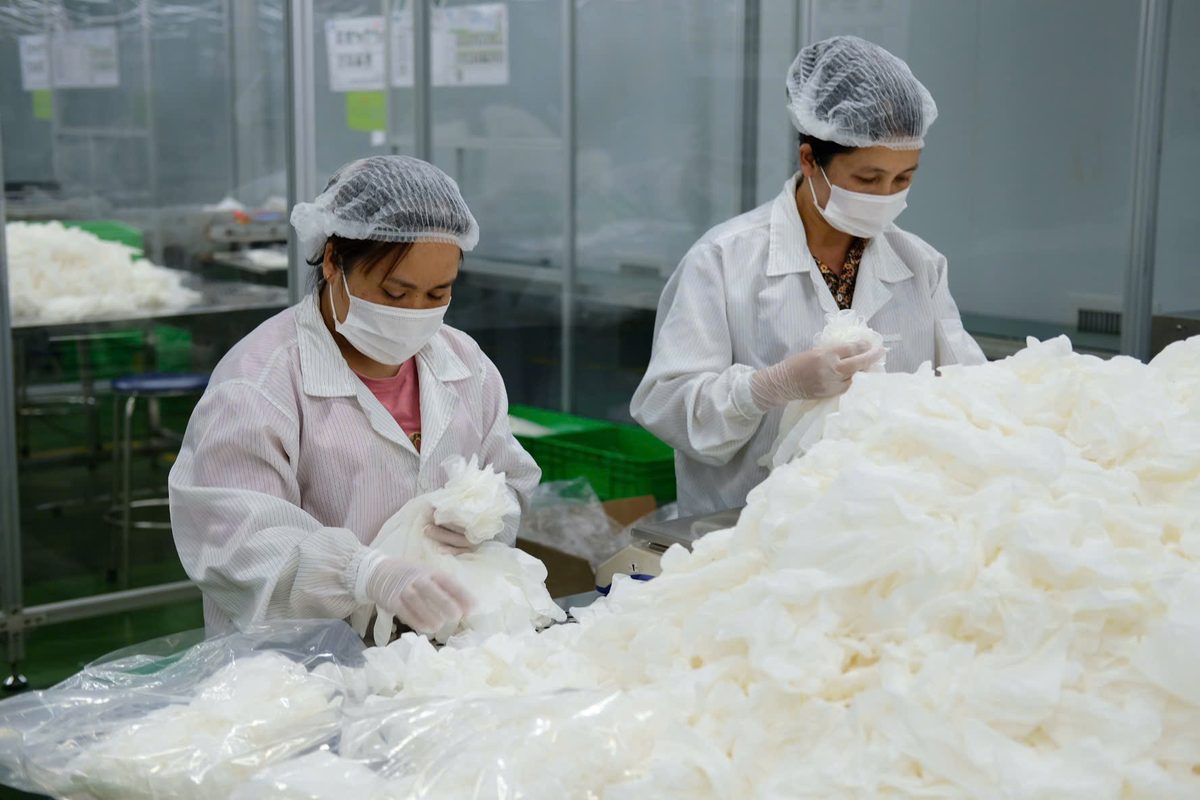
Thái Hòa Gloves manufactures disposable gloves for industrial and cleanroom applications, with a focus on supplying gloves to manufacturers that require consistent quality and reliable supply.
Our factory-based production capability allows us to support B2B customers with:
- Nitrile gloves
- Powder-free disposable gloves
- Cleanroom gloves
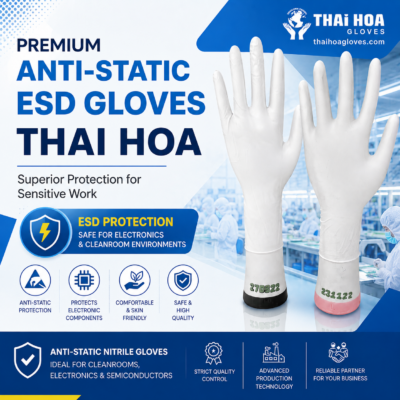
- ESD-compatible glove solutions
- Gloves for electronics manufacturing
- Gloves for precision industrial applications
For semiconductor and electronics manufacturers, selecting the right glove is an important part of maintaining a controlled production environment.
Thái Hòa Gloves focuses on product quality, production consistency, and supply capability to support long-term industrial customers.
Conclusion
Choosing the right disposable gloves for wafer handling requires a balance between puncture resistance, purity, flexibility, tactile sensitivity, and contamination control.
For semiconductor and cleanroom environments, powder-free nitrile gloves can be a practical option when they are manufactured and processed according to the required cleanliness standards.
Before purchasing, manufacturers should evaluate glove material, cleanliness, particle control, mechanical strength, chemical compatibility, packaging, and supplier reliability.
If your factory is looking for cleanroom gloves, nitrile gloves, or gloves for electronics and semiconductor manufacturing, Thái Hòa Gloves can provide factory-direct solutions for B2B requirements.
Contact Thái Hòa Gloves for product information and quotations:
📞 Hotline: 0982 832 915
Thái Hòa Gloves – Factory Direct | Cleanroom Gloves | Nitrile Gloves | Industrial Solutions
Address: Lot TT3, Diem Thuy Industrial Park, Pho Yen Ward, Thai Nguyen Province, Vietnam
Tel: 0208 393 1991 – Hotline: 0982 832 915
Email: info@thaihoagloves.com