

In industries where contamination control and worker safety are essential, selecting the right disposable glove is a critical decision. From semiconductor manufacturing and electronics assembly to pharmaceutical production and cleanroom laboratories, gloves are the first line of defense against contamination, chemicals, and mechanical hazards.
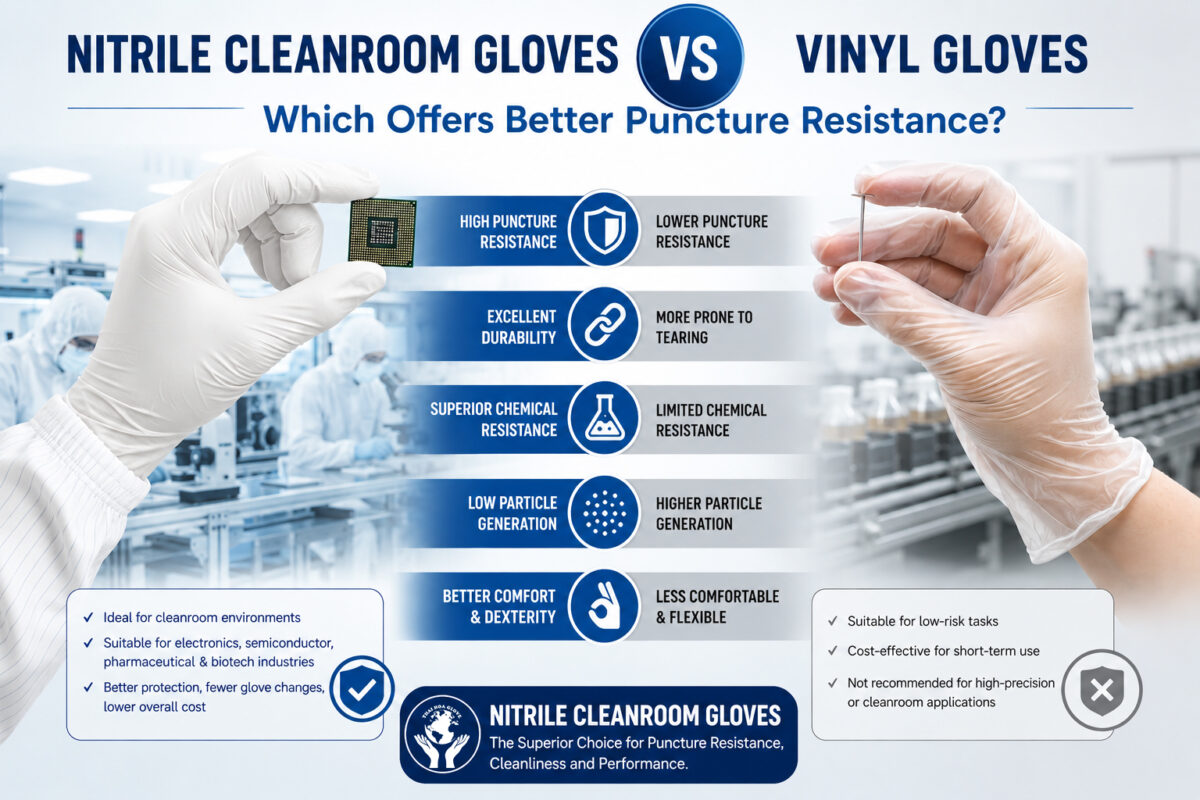
Among the most commonly used disposable gloves are Nitrile Cleanroom Gloves and Vinyl Gloves. While both serve as protective barriers, they differ significantly in material composition, durability, flexibility, and puncture resistance.
If your facility requires reliable hand protection in demanding environments, understanding these differences can help you make the right investment.
In this article, we’ll compare Nitrile Cleanroom Gloves vs. Vinyl Gloves, with a particular focus on puncture resistance and overall performance.
Understanding Nitrile Cleanroom Gloves
Nitrile gloves are manufactured from synthetic nitrile butadiene rubber (NBR), a latex-free material engineered to provide exceptional strength and chemical resistance.
Unlike standard disposable gloves, cleanroom nitrile gloves undergo specialized manufacturing and cleaning processes to minimize:
- Particle generation
- Ionic contamination
- Extractable residues
- Surface contaminants
These gloves are widely used in:
- Semiconductor manufacturing
- Electronics assembly
- Pharmaceutical production
- Biotechnology
- Medical device manufacturing
- Aerospace cleanrooms
Because of their superior mechanical properties, nitrile gloves have become the preferred choice in contamination-controlled environments.
What Are Vinyl Gloves?
Vinyl gloves are made from polyvinyl chloride (PVC) combined with plasticizers to create flexibility.
They are generally considered an economical option for light-duty tasks that require frequent glove changes.
Common applications include:
- Food handling
- Housekeeping
- Hospitality
- General cleaning
- Low-risk inspection tasks
Although vinyl gloves offer cost advantages, they are not designed for applications requiring high durability or puncture protection.
Why Puncture Resistance Matters
Puncture resistance refers to a glove’s ability to withstand sharp objects or mechanical stress without tearing or perforating.
In cleanroom environments, glove punctures can result in:
- Product contamination
- Exposure to hazardous chemicals
- Equipment damage
- Increased production downtime
- Higher replacement costs
Even microscopic punctures can compromise sterile manufacturing processes and reduce product quality.
Therefore, puncture resistance should be one of the most important considerations when selecting disposable gloves.
Nitrile vs. Vinyl: Material Strength
The biggest difference between nitrile and vinyl lies in their molecular structure.
Nitrile rubber possesses excellent elasticity while maintaining high tensile strength.
This enables nitrile gloves to:
- Stretch without tearing
- Recover their original shape
- Resist punctures
- Maintain integrity during prolonged use
Vinyl, on the other hand, has a relatively rigid molecular structure.
Although plasticizers improve flexibility, vinyl remains:
- Less elastic
- More brittle
- More susceptible to tearing
- Easier to puncture under pressure
As a result, nitrile consistently outperforms vinyl in demanding work environments.
Comparing Puncture Resistance
Nitrile Gloves
Nitrile gloves offer outstanding puncture resistance because they combine:
- High tensile strength
- Excellent elasticity
- Superior abrasion resistance
- Strong tear resistance
Workers handling:
- Sharp electronic components
- Precision instruments
- Metal edges
- Laboratory equipment
benefit from the enhanced durability of nitrile gloves.
Many studies indicate that nitrile gloves provide approximately three times greater puncture resistance than comparable latex gloves while significantly outperforming vinyl gloves.
Vinyl Gloves
Vinyl gloves perform adequately for low-risk applications but struggle when exposed to:
- Sharp edges
- Repetitive stretching
- Mechanical stress
- Continuous movement
Because vinyl has lower elasticity, punctures often develop more quickly after repeated use.
This makes vinyl unsuitable for high-precision manufacturing or cleanroom operations where glove integrity is critical.
Performance in Cleanroom Environments
Cleanrooms demand more than puncture resistance.
Disposable gloves must also minimize contamination risks.
High-quality nitrile cleanroom gloves offer:
- Low particle emission
- Low ionic contamination
- Excellent cleanliness
- Strong chemical resistance
- Consistent thickness
- Excellent tactile sensitivity
Vinyl gloves generally produce higher levels of particles and are rarely recommended for ISO-classified cleanrooms.
For semiconductor, pharmaceutical, and electronics manufacturing, nitrile remains the industry standard.
Chemical Resistance Comparison
Another major advantage of nitrile gloves is their superior resistance to chemicals.
They provide excellent protection against:
- Oils
- Grease
- Solvents
- Cleaning agents
- Laboratory chemicals
- Alcohol-based disinfectants
Vinyl gloves provide only limited resistance to chemicals and may degrade when exposed to aggressive substances.
Facilities working with chemicals should always prioritize nitrile gloves.
Comfort and Dexterity
Workers often wear gloves for several hours at a time.
Comfort directly affects productivity.
Nitrile Gloves
Offer:
- Excellent flexibility
- Snug fit
- High finger sensitivity
- Reduced hand fatigue
- Better grip
These characteristics are especially valuable during precision assembly.
Vinyl Gloves
Typically have:
- Looser fit
- Reduced elasticity
- Lower tactile sensitivity
- Less secure grip
Although suitable for short-duration tasks, they are less comfortable during extended wear.
Cost Considerations
Vinyl gloves are generally less expensive than nitrile gloves.
However, purchase price should not be the only factor.
Because vinyl gloves puncture more easily, facilities often experience:
- Higher glove consumption
- More frequent glove replacement
- Increased downtime
- Greater contamination risks
Nitrile gloves typically have a higher upfront cost but offer better long-term value due to:
- Longer service life
- Lower replacement frequency
- Improved worker protection
- Reduced product defects
For many manufacturers, the total cost of ownership favors nitrile.
Industry Applications
Semiconductor Manufacturing
Semiconductor production requires:
- Ultra-clean environments
- Precision handling
- Electrostatic protection
- Low particle generation
Nitrile cleanroom gloves are the preferred choice.
Electronics Assembly
Electronic components are highly sensitive to contamination.
Workers require gloves that provide:
- Excellent dexterity
- High puncture resistance
- Low lint
- Reliable grip
Nitrile gloves meet these requirements effectively.
Pharmaceutical Manufacturing
Drug production demands strict contamination control.
Nitrile cleanroom gloves help maintain sterile manufacturing conditions while protecting operators.
Medical Device Manufacturing
Medical devices require consistent quality standards.
Durable nitrile gloves reduce contamination risks and improve production reliability.
Food Processing
Vinyl gloves are often used for basic food handling.
However, nitrile gloves provide greater durability when workers handle sharp tools or repetitive tasks.
Environmental Considerations
Modern manufacturers are increasingly focusing on sustainability.
Many premium nitrile gloves are now produced using advanced manufacturing technologies that reduce:
- Water consumption
- Energy usage
- Carbon emissions
Additionally, their longer lifespan results in lower overall glove waste.
Which Glove Should You Choose?
Choose Nitrile Cleanroom Gloves if you require:
- Superior puncture resistance
- Cleanroom compatibility
- Excellent durability
- Better chemical resistance
- Precision handling
- Extended wear comfort
- High-quality manufacturing environments
Choose Vinyl Gloves only when:
- Tasks are low risk
- Mechanical hazards are minimal
- Frequent glove replacement is acceptable
- Budget is the primary concern
Final Verdict
When comparing Nitrile Cleanroom Gloves vs. Vinyl Gloves, the winner in puncture resistance is clear.
Nitrile gloves deliver significantly higher durability, greater flexibility, superior chemical resistance, and enhanced protection against punctures. These advantages make them the preferred choice for industries where contamination control, worker safety, and product quality cannot be compromised.
Although vinyl gloves remain a cost-effective solution for light-duty applications, they simply cannot match the performance of nitrile in demanding environments.
For semiconductor manufacturing, electronics assembly, pharmaceuticals, biotechnology, laboratories, and other cleanroom industries, investing in premium Nitrile Cleanroom Gloves ensures greater reliability, lower operational risks, and improved productivity.
Choosing the right glove is more than a purchasing decision—it is an investment in product quality, employee safety, and long-term operational efficiency.
Frequently Asked Questions (FAQ)
Are nitrile gloves stronger than vinyl gloves?
Yes. Nitrile gloves offer significantly higher tensile strength, tear resistance, and puncture resistance than vinyl gloves, making them suitable for demanding industrial and cleanroom applications.
Can vinyl gloves be used in cleanrooms?
Vinyl gloves are generally not recommended for ISO-classified cleanrooms because they generate more particles and provide lower mechanical durability than cleanroom-certified nitrile gloves.
Which gloves are better for electronics manufacturing?
Nitrile cleanroom gloves are the preferred option due to their excellent dexterity, low particle generation, superior puncture resistance, and compatibility with ESD-sensitive environments.
Are nitrile gloves worth the higher price?
In most industrial settings, yes. Although nitrile gloves have a higher initial cost, their longer lifespan, lower replacement rate, and better protection often result in a lower total cost of ownership.
What industries benefit most from nitrile cleanroom gloves?
Industries such as semiconductor manufacturing, electronics, pharmaceuticals, biotechnology, medical device production, aerospace, and laboratory research benefit the most from the superior performance of nitrile cleanroom gloves.